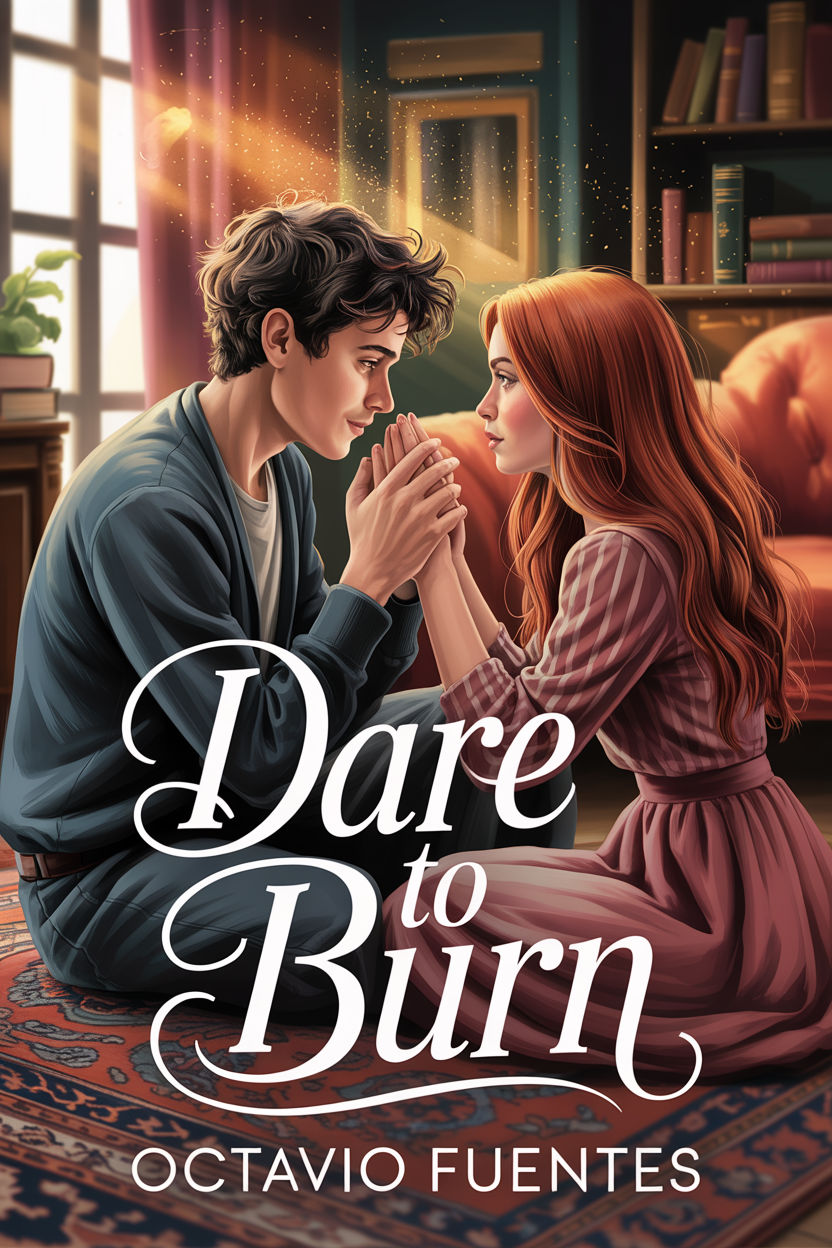
You know that feeling when you start a fake dating romance telling yourself it’s just a fun trope — a light read, nothing too intense — and then somewhere around the third chapter you realize you’ve been holding your breath and the guy you were supposed to hate is already living in your head rent-free? Dare to Burn did that to me. I started it before bed on a Tuesday and looked up bleary-eyed at 2 AM with half a cup of cold tea going untouched beside me, absolutely furious at Julian Blaze and completely unable to put him down.
The Story
Harper West has never broken a rule in her life. She’s the girl with perfect attendance, a GPA that could get her out of her small town, and a very sensible plan to keep her head down and survive senior year. Then she ends up at a party she doesn’t want to be at, in a Truth or Dare circle she should have left the moment she sat down, and suddenly she’s kissing Julian Blaze — Evergreen High’s resident bad boy, the guy who already got her a week of detention — in front of half her class.
The game was rigged. The kiss was real. And the penalty is thirty days of fake dating the one person most likely to blow up her carefully organized life.
Julian is arrogant, infuriating, and completely impossible to ignore. He knows her class rank, her mom’s work schedule, and exactly which spot on her neck makes her forget how to form a coherent thought. Harper goes in planning to keep things surface-level. She does not succeed. Neither does he — and that’s where the real story begins.
What Hooked Me
The chemistry is immediate and relentless. Even in chapter one, when Julian is more of a shadowy presence than a fully drawn character, the tension crackles. He saves her from a drunk harasser at a party, delivers a parting insult, and still somehow plants a seed of something she can’t name. By the time he’s soaking himself in the rain outside school just to make her accept a ride home, I was gone.
What makes the romance work isn’t just the heat — it’s the way Julian pays attention. He knows which parking lot exits to use so her mom won’t worry. He tracks down her favorite drive-in event for their first real date. He takes her to his lighthouse, the place that belongs only to him, and you feel the weight of that gift even before he tells her so. For all his armor of arrogance, Julian Blaze is someone who has been watching Harper West for a long time. And when he finally stops pretending he hasn’t, the slow unfurling of that is genuinely delicious.
Harper herself is easy to root for. The author doesn’t make the mistake of writing her as passive — yes, she starts the story as a rule-follower, but she has spine. When Madison tries to humiliate her at Truth or Dare, Harper stands up and calls her bluff. When Julian provokes her in class, she doesn’t shrink — she gets detention. And by the book’s middle act, she’s getting suspended, walking home alone in her fury, sketching angry charcoal lines that suspiciously resemble Julian’s shoulders. That growth feels earned, not handed to her.
The piano scene in chapter thirteen is probably the reason most readers will recommend this book to their friends. Julian has pulled Harper into a soundproofed music room, and he wants to open up about his past, his brutal father, all the things he’s never told anyone — but he physically can’t seem to do it without her hands on him. So they end up doing both at the same time: her touching him while he talks, sensation and confession braided together into something that’s intimate in a way that goes far deeper than what’s happening physically.
“I’ve never felt this way before,” he admitted quietly. “It scares the hell out of me.”
That’s the line that got me. Not the heated moments, though there are plenty of those. It’s the fact that Julian Blaze — the most closed-off person in any room — is scared. And Harper is the reason.
The abusive father subplot adds genuine weight to Julian’s walls. His sudden disappearances, the bruises he won’t explain, the way he shuts down the moment his father shows up — it reframes every bit of cruelty Julian directs at Harper during his worst moments. He’s not just a jerk. He’s someone who learned early that caring about people gives other people ammunition to destroy you. Watching him unlearn that — slowly, imperfectly — is what makes this more than a standard bad boy fantasy.
What Didn’t Quite Land
The middle section of the book runs one push-pull cycle too many. Julian opens up, then slams a wall back down, then Harper reaches toward him again, then he retreats — and by the fourth or fifth iteration, the rhythm starts to feel mechanical rather than agonizing. The emotional beats land better when the reason for Julian’s retreat is clearly tied to something external (his father’s visits, genuine fear of attachment) versus when it reads more like plot stalling.
Hunter Brooks, the golden-boy lab partner introduced as a rival for Harper’s attention, never becomes a character in his own right. He’s there to make Julian jealous, and he does that job competently, but the book hints at “history” between Julian and Hunter that never fully materializes. That teased thread dangles throughout and doesn’t pay off — which might be intentional setup, but it reads more like a loose end.
A few scenes also repeat the same emotional note: Julian says or does something cruel, Harper is devastated, and then she resolves to be stronger and move on. This is a very real emotional experience, and I don’t doubt it’s authentic. But it’s one the book returns to slightly too often, and each repetition dilutes the impact of the next one.
The Verdict
Dare to Burn is exactly the book you want when you’re craving a fake dating romance that actually delivers on its emotional promise. The setup is classic, but the execution has real heart — a heroine who grows into herself rather than getting polished by the love interest, and a hero whose damage is rendered with enough specificity that you understand his behavior even when you want to shake him.
It gets spicy at the right moments, and those moments feel like they belong to the story rather than being stapled on for shock value. The heat serves the tension. The tension serves the characters. And if you find yourself at midnight having abandoned your tea, reading about a piano and a music room and a boy who can barely say what he means except when his hands are busy doing it — well. You were warned.
Content note: the book depicts an abusive parent and resulting emotional distress. Nothing graphic, but it’s present.
Perfect for: Fans of Tammara Webber’s Easy or any Mariana Zapata slow burn who want a shorter, faster-paced fix. If fake dating agreements, jealous heroes who watch you across cafeterias, and first kisses that ruin you for all other kisses are your genre — start here.